Most driveway gate failures trace back to three things: power, command signal, or a blocked sensor. Check your breaker and GFCI outlet first, then test the wired wall station or keypad, and finally look for anything blocking the photo eyes. If those three checks come back clean and the gate still won’t move or reverses on its own, you’re likely looking at a mechanical or electrical fault that needs a licensed technician, not a screwdriver.
TL;DR:
- Power issues remain the primary cause of driveway gate failures, with tripped breakers, blown fuses, or disconnected batteries being most common.
- Misaligned, dirty, or blocked sensors are frequent culprits, especially after heavy rain causes corrosion or debris buildup.
- The gate motor humming without movement typically indicates capacitor or gearbox failure, requiring professional repair rather than DIY efforts.
- Routine maintenance, including sensor cleaning, track clearance, and electrical inspections, significantly reduces failure rates and safety risks.
- Professionals should be consulted for control board, wiring, or mechanical repairs involving electrical danger or complex component replacements.
Table of Contents
- Driveway Gate Troubleshooting: The Quick Diagnosis Flow
- What Causes Most Driveway Gate Problems?
- How Do I Fix a Malfunctioning Driveway Gate Myself?
- When Should You Call a Professional Gate Technician?
- Driveway Gate Maintenance Checklist
- What Field Experience Teaches About Gate Failures
- How Easton Fencing Handles Automatic Gate Repair in North Texas
- Where to Find More Gate Troubleshooting Help
- Sources
- FAQ
Driveway Gate Troubleshooting: The Quick Diagnosis Flow
Before touching any wiring, cut power to the operator and use lockout/tagout so the gate can’t cycle while you’re working near it. Once the system is safe to inspect, work through these checkpoints in order:
- Power — Confirm the breaker hasn’t tripped and the GFCI outlet feeding the operator hasn’t popped. Check for status lights on the control board; a dark panel usually means no power is reaching the unit at all.
- Command input — Press the wired wall station or type your keypad code. If the gate responds here but ignores your remote, the fault is isolated to the remote or receiver, not the gate itself.
- Sensors — Look at the photo eye LEDs. A solid or blinking pattern that changes when you wave a hand between them means alignment is fine; no change points to a dirty lens or misalignment.
- Path — Walk the full swing or slide path and clear branches, gravel, or toys.
- Operator sound — Listen for a hum with no movement, which usually signals a motor or capacitor problem rather than a simple obstruction.
This ordered checkpoint approach catches the majority of faults without opening a single panel screw. Most driveway gate motor troubleshooting starts with elimination, not repair.
What Causes Most Driveway Gate Problems?
Once you know which checkpoint failed, matching the symptom to its likely cause narrows the fix fast. Electric gate issues cluster into a handful of repeatable patterns, and power problems account for the largest share of them, which is why that’s always the first stop.
- No response at all: tripped breaker, popped GFCI, blown fuse, or a disconnected battery backup terminal.
- Gate opens but won’t close: blocked or misaligned photo eyes, or a safety edge sensor stuck in the triggered position.
- Remote or keypad not working: dead batteries, a code that fell out of programming, or a receiver losing power intermittently.
- Motor hums but the gate doesn’t move: a failing start capacitor, a stripped drive gear, or a seized gearbox.
- Gate stops or reverses mid cycle: force or limit settings set too tight, a track binding on debris, or a safety input firing falsely.
- Works fine, then fails in wet weather: water getting into low-voltage connections, terminal corrosion, or rodent damage to buried wiring.
That last pattern shows up constantly in North Texas after a hard rain, and corrosion at low-voltage terminals is often the real culprit behind a gate that “worked yesterday.” A quick visual check of terminal color, before you assume the motor itself has failed, saves a lot of wasted diagnostic time.
How Do I Fix a Malfunctioning Driveway Gate Myself?
A malfunctioning driveway gate often responds to the same handful of homeowner-safe fixes, in the same order every time. Work through them methodically rather than jumping straight to the motor.
- Check power first. Reset the breaker, reset the GFCI, and confirm the operator’s on/off switch is actually on. If you have battery backup, disconnect it before touching any wiring inside the cabinet.
- Test command inputs. Try the wired wall station or keypad. Swap remote batteries before assuming a receiver problem. Most transmitters re-pair by holding a “learn” button on the board while pressing the remote button twice, though exact steps vary by brand.
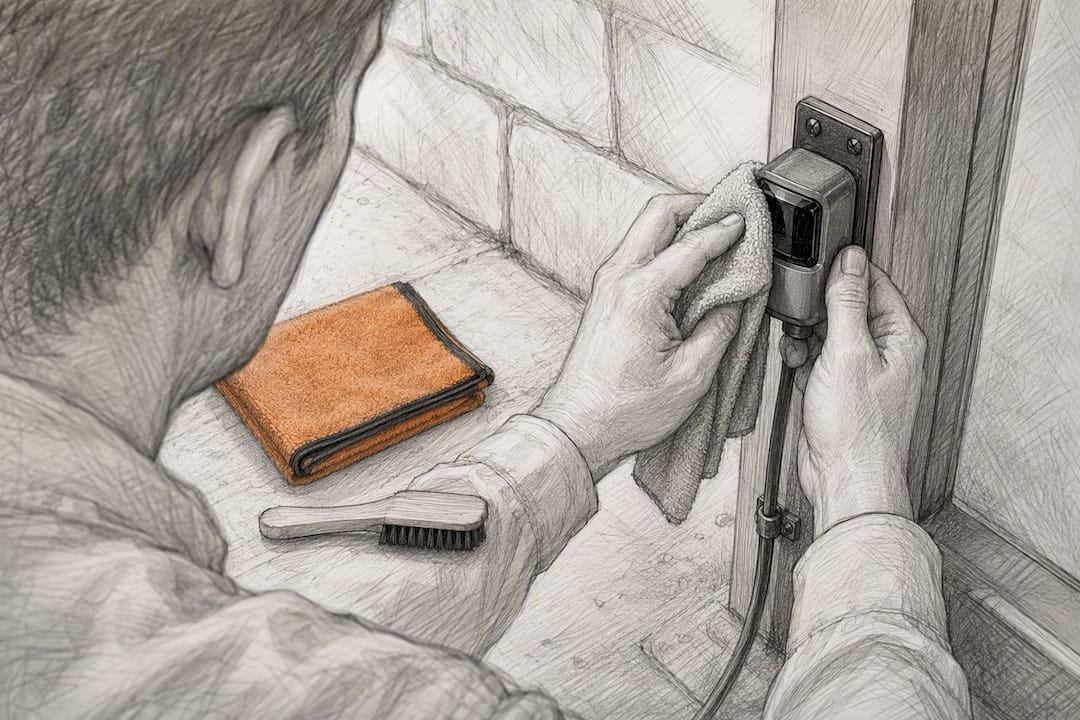
- Clean and align sensors. Wipe photo eye lenses with a soft cloth and confirm the transmit and receive units still face each other directly; a knocked post throws off alignment more often than people expect.
- Inspect the track and rollers. Trigger the manual release, push the gate by hand, and feel for binding. Clear debris and lubricate hinges and rollers with a silicone or lithium grease. Avoid petroleum jelly or heavy oils, which attract grit and gum up the mechanism.
- Look, don’t touch, at the electrical. Scan for burn marks, melted insulation, or corroded, loose cable glands. Never open a live mains connection; that’s the line where DIY stops.
Pro Tip: Photograph any diagnostic code or blinking LED pattern on the control board before you call for service. Manufacturer manuals reference specific fault codes, and handing a technician that code often cuts the visit in half.
If the motor hums steadily but the gate won’t budge even after you’ve cleared the track, stop. That combination almost always means a capacitor or gearbox failure, not something a homeowner should force open.
When Should You Call a Professional Gate Technician?
Some repairs cross a line where a wrench and good intentions aren’t enough. Stop troubleshooting and call a licensed technician when you’re dealing with:
- Control board failures, bad capacitors, or mains wiring, since these carry shock risk and often require specialized meters to diagnose safely.
- Motor swaps or major frame or gearbox repairs, which usually need lifting equipment and precise realignment.
- A burning smell, melted insulation, or any wiring that feels warm to the touch.
- A gate that could fall, swing unexpectedly, or pinch someone; a heavy iron gate that’s lost its safety stop is a genuinely dangerous piece of equipment.
When you do call, ask for proof of insurance, experience with UL 325 safety and monitored entrapment protection standards, and a written quote with a warranty before any work starts.
Driveway Gate Maintenance Checklist
A little routine attention prevents most of the failures covered above before they ever start.
Monthly: Wipe down photo eye sensors, clear the track of leaves and debris, test the remote, and confirm the manual release still disengages smoothly.
Quarterly: Lubricate hinges and rollers, check cable entry seals for cracking, and test battery backup voltage if your system has one.
Annually: Schedule a professional safety test, including force and limit verification and a full electrical inspection.
Keep a simple written log of dates and any diagnostic codes you notice. It turns a vague “it’s been acting weird” into specifics a technician can act on immediately.
| Interval | Task | Why it matters |
|---|---|---|
| Monthly | Clean sensors, clear track, test remote | Catches obstruction and battery issues early |
| Quarterly | Lubricate hinges, check seals, test battery voltage | Prevents corrosion and binding before they cause a stall |
| Annually | Professional safety test, force/limit check | Confirms UL 325 entrapment protection still functions correctly |
What Field Experience Teaches About Gate Failures
After years of service calls across Collin County, the pattern holds: simple checks solve most gate problems long before anyone reaches for a wrench. Power interruptions and dirty sensors cause more stalls than worn motors ever do. Routine maintenance and in-house craftsmanship, rather than parts swapped in after the fact, are what actually stop the same fault from repeating every few months.
— Justin
How Easton Fencing Handles Automatic Gate Repair in North Texas
Eastonfencingtx offers in-house diagnosis, repair, and installation of automatic gates without using subcontractors.

When your troubleshooting points to a failed capacitor, a cracked control board, or a mechanical binding that’s beyond a hand lubrication job, that’s exactly where our crews step in. We handle everything from routine inspections to emergency repairs on cedar and wrought iron gate systems, and every job carries fully insured work backed by hands-on craftsmanship. If your gate’s issue involves electrical components, motor replacement, or a mechanical failure that could put someone at risk, don’t keep experimenting. Get a fast, free estimate through our automatic gate services page and we’ll have a craftsman look at it directly.
Where to Find More Gate Troubleshooting Help
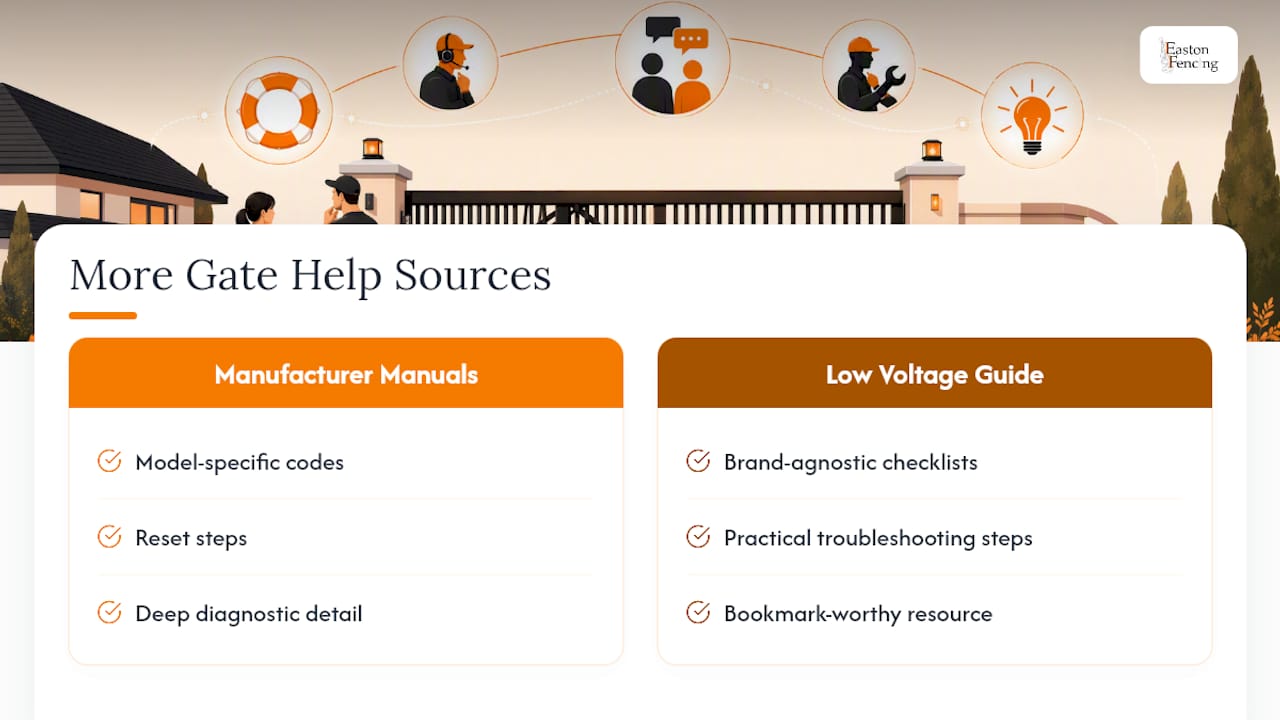
For deeper diagnostic detail, manufacturer manuals cover model-specific codes and reset steps, while the Low Voltage Corp troubleshooting guide offers practical, brand-agnostic checklists worth bookmarking.
Sources
- Electric gate troubleshooting guide — Wisenet Security
- Motorized gate troubleshooting guide for managers – Low Voltage Corp
FAQ
What are the common problems with outdoor gates?
The most frequent issues are power interruptions, dirty or misaligned photo eye sensors, dead remote batteries, and debris caught in the track or rollers.
What causes an automatic gate to malfunction?
Automatic gates typically malfunction due to tripped breakers, blocked safety sensors, worn start capacitors, or force and limit settings that have drifted out of adjustment.
How do I reset my electric gate?
Most systems reset by cutting power at the breaker for a short interval, then restoring it and observing whether the control board’s status lights return to normal; exact reset button locations vary by brand, so check your manufacturer’s manual for the precise sequence.
Why isn’t my driveway gate closing?
A gate that won’t close is almost always caused by a blocked or misaligned photo eye, a triggered safety edge, or a limit setting that’s stopping the gate short of full travel.
When should I stop troubleshooting and call a technician?
Stop as soon as you smell burning, see melted insulation, or suspect a control board or capacitor failure. At that point, contact a professional through a page like Easton Fencing’s Allen, TX service line rather than opening electrical components yourself.