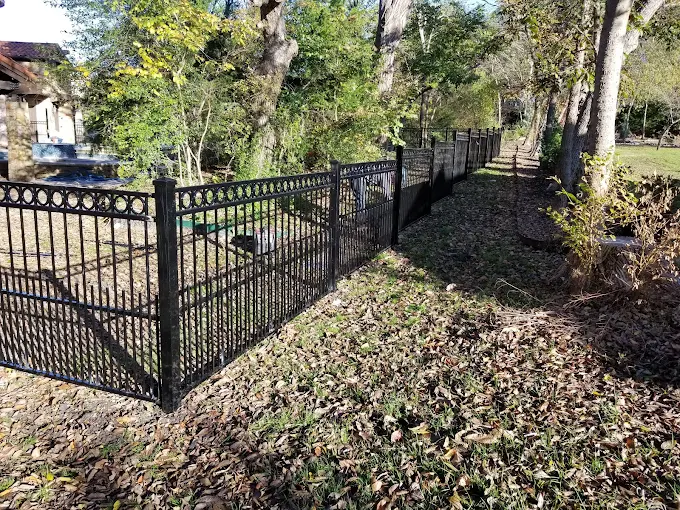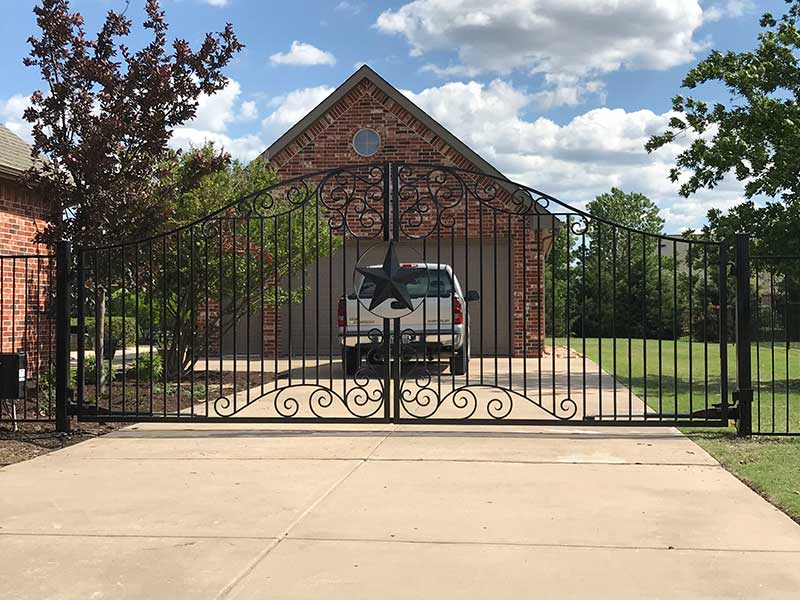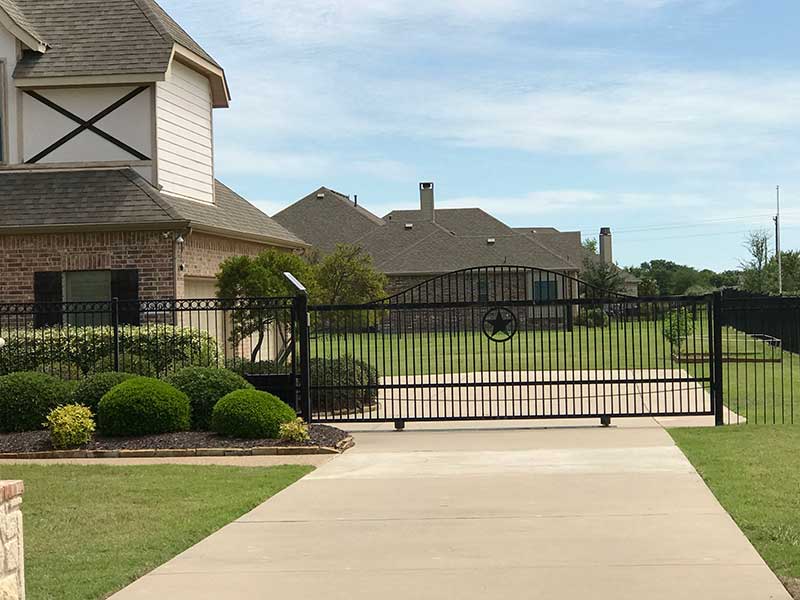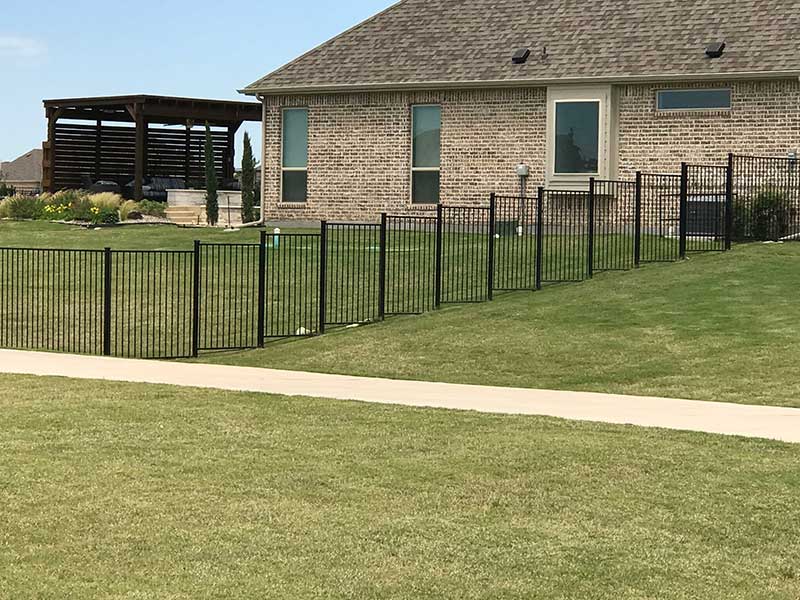
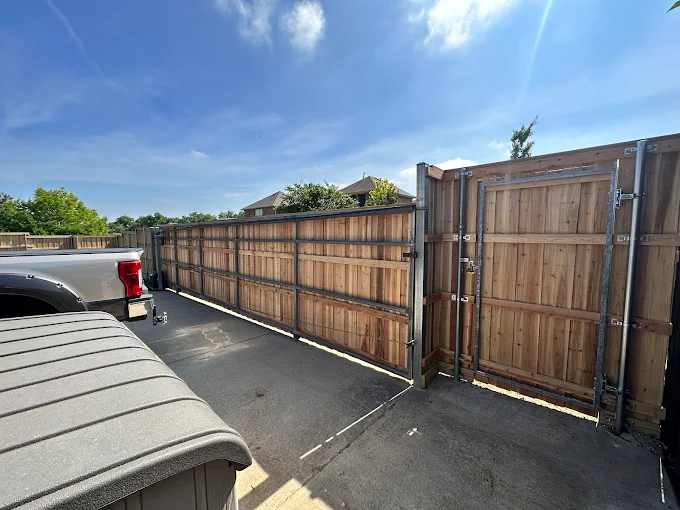
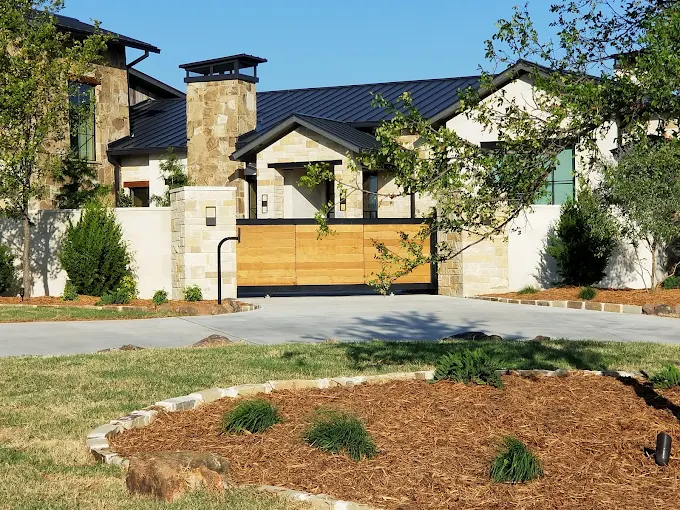
Automatic driveway gates are usually the single most visible upgrade a North Texas property owner makes. It is the first thing guests see, the last barrier between the street and your home, and — if it is built wrong — the thing that stops working every time the ground moves.
After 17 years installing gates across Parker, Lucas, Prosper, Celina, Allen, Wylie, Anna, and Fairview, we have learned that most gate problems are not gate problems at all. They are soil problems, slope problems, and code problems that were never addressed before the first post went in the ground.
This guide walks through how automatic gates actually work, how to choose between swing and slide, why Collin County clay changes the engineering, what safety standards a legal installation must meet, and the questions that separate a gate that lasts thirty years from one that sags in three.
What Is an Automatic Driveway Gate and How Does It Work?
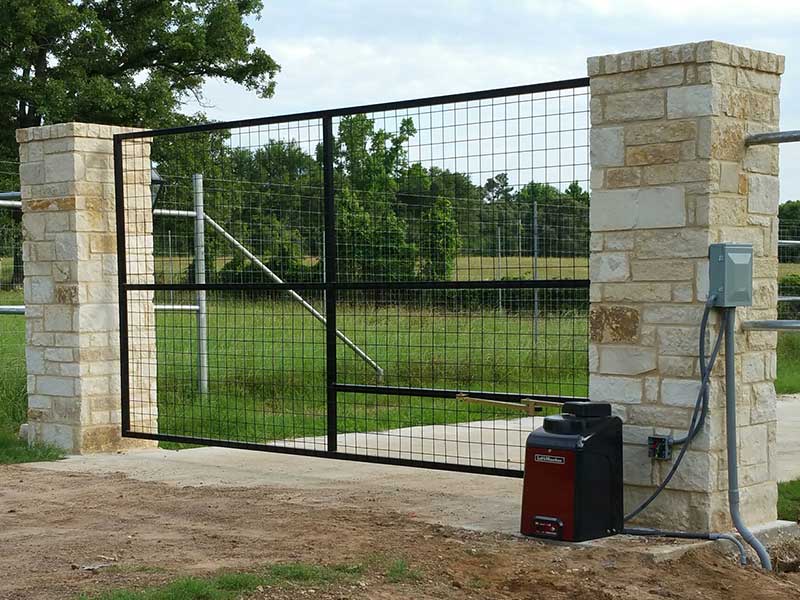
An automatic driveway gate is a vehicular gate powered by an electric operator that opens and closes it without manual effort. The system has four parts: the gate itself, the operator (motor), the access controls that trigger it — keypad, remote, phone app, or vehicle sensor — and the safety devices that stop the gate when something is in its path.
The gate leaf and the operator are engineered as a matched pair. A 16-foot wrought iron swing leaf and a lightweight aluminum slider need completely different motors, different post foundations, and different safety hardware. This is why a gate bought online and paired with a generic opener so often fails: the components were never sized to each other.
Access is typically a combination of a keypad at the driveway entrance, remotes for household vehicles, and a safety loop or photo eye that prevents the gate from closing on a car. Many Collin County homeowners add cellular intercoms so they can buzz in a delivery driver from anywhere.
Swing Gate or Slide Gate? How to Choose
Choose a swing gate when your driveway is level and you have clear space for the gate to arc open. Choose a slide gate when the driveway slopes, space is tight, or you want fewer moving parts exposed to soil movement. For most Collin County estate properties, the deciding factor is grade — not aesthetics.
| Factor | Swing gate | Slide gate |
|---|---|---|
| Sloped driveway | Struggles past roughly a 10% slope in the swing path | Handles slope well; moves parallel to grade |
| Space required | Needs clear arc, inside or outside the property line | Needs side run-out roughly equal to gate width |
| Clay soil movement | Post shift causes sag, drag, and latch failure | Cantilever design avoids ground track entirely |
| Curb appeal | Classic estate look; ornamental scrollwork shows well | More utilitarian, though custom iron slides look excellent |
| Moving parts | Fewer; simpler mechanically | More hardware; rollers and cantilever arms |
| Typical fit | Level acreage entries, dual-swing estate drives | Sloped drives, narrow frontage, heavy daily use |
When a swing gate is the right call
Swing gates suit the wide, level driveway entries common on Parker’s one-acre-minimum lots and Lucas’s larger tracts. A dual-swing entry with matched ornamental iron leaves is the classic North Texas estate look, and with fewer moving parts, there is less to service over time.
The catch is geometry. A swing gate needs a clear, level arc. If your driveway rises toward the house — very common in Prosper and Celina’s newer developments — the leading edge of the leaf will drag before it finishes opening. Grading the arc can solve this, but that cost often exceeds the difference between a swing and a slide.
When a slide gate wins
Cantilever slide gates handle slope, and they eliminate the ground track that clay soil loves to heave. That combination makes them the safer engineering choice on properties where the driveway is anything other than flat, or where the entry sits close to the road with no room for a leaf to swing.
They cost more up front because of the hardware. They also cost less over a decade, because there is no post-sag realignment every time the soil goes through a wet-dry cycle.
Why Collin County Clay Soil Decides Half the Gate Design
Collin County sits on expansive clay that swells during wet seasons and shrinks during drought. That movement lifts, drops, and tilts gate posts — and a gate post that moves half an inch will throw a heavy gate out of alignment. This is the single biggest cause of automatic gate failure in North Texas, and it is almost entirely preventable at installation.
A driveway gate post is not a fence post. It carries a cantilevered load that multiplies leverage against the soil every time the gate swings. Getting it right means:
- Deeper, wider footings than code minimums. Gate posts need to reach below the zone of seasonal moisture change, not just satisfy a residential fence guideline.
- Properly sized steel. Undersized posts flex under load, and flex becomes permanent lean.
- Drainage away from the footing. Water pooling at the base accelerates the swell-shrink cycle that moves the post.
- Adjustable hardware. Hinges and roller assemblies that can be re-shimmed let a gate be brought back into alignment without excavation.
This is the same soil behavior that determines how we set every wood and iron fence line in the region. If you want the detail on how material choice interacts with North Texas conditions, our comparison of cedar and iron fence construction covers it, and our guide to how long a wrought iron fence lasts in North Texas explains the maintenance side.
Safety Codes Every Automatic Gate Must Meet
Automatic vehicular gates in the United States are governed by two standards: UL 325, which covers the operator and its entrapment protection, and ASTM F2200, which covers the physical construction of the gate itself. A compliant installation has to satisfy both. A gate that meets one and not the other is not code-compliant, regardless of how well it works.
UL 325 requires the operator to detect an obstruction and stop or reverse before causing harm, using independent means of entrapment protection — typically some combination of inherent force sensing, photo eyes, and edge sensors.
ASTM F2200 governs the gate structure. Its requirements include guarding exposed rollers, screening openings on slide gates, sizing gaps so a small child cannot reach through or become entrapped, and designing the gate so it cannot fall over more than 45 degrees if it detaches from its hardware. Residential installations fall under Class I usage. The Door & Access Systems Manufacturers Association publishes a plain-language installer’s guide to ASTM F2200 that is worth reading before you sign a contract.
Ask any installer directly whether they build to UL 325 and ASTM F2200. If the answer is vague, keep looking. Entrapment injuries involving automatic gates are rare precisely because these standards exist — and they only work if someone follows them.
Permits, HOA Approval, and Emergency Access
Most Collin County cities require a permit for a fence, and gates with automated openers almost always require one. Requirements vary meaningfully between municipalities, so verify with your city before ordering materials.
The City of Allen’s residential fence guidelines, for example, cap most residential fencing at eight feet, specify metal posts and hardware, require posts set in concrete, and prohibit fencing in floodplain areas or unapproved easements. Gates with automated openers are explicitly called out as requiring a permit. Neighboring cities set their own heights, setbacks, and corner-visibility rules.
Three items homeowners routinely overlook:
- Emergency access. Fire departments across North Texas require a way through a gated entry — commonly a Knox key switch or an approved manual-release disconnect. Frisco’s fire lane gate policy is a good illustration of what North Texas fire marshals look for, though the specific rules that apply to a single-family driveway differ from those governing a fire lane. Confirm your city’s requirement during design, not after inspection.
- HOA architectural approval. In master-planned communities across Prosper, Celina, and Fairview, HOA approval is a separate process from the city permit and often takes longer. Our guide to getting HOA approval for a fence in North Texas walks through the submittal.
- Utility locates. Texas law requires contacting Texas811 at least two business days before digging. Gate post holes go deep enough to matter, and the tolerance zone around a marked line must be hand-dug.
What to Ask Before You Hire a Gate Installer
Ask these five questions. The answers will tell you more than any brochure:
- Who actually does the work? Many companies subcontract gate installation to a separate crew. Every Easton Fencing installation is performed by our own in-house employees — no subcontractors — which is how we hold quality consistent from footing to final alignment.
- How deep are the gate post footings, and why that depth? A specific answer that references soil conditions is a good sign. “Standard depth” is not.
- Do you build to UL 325 and ASTM F2200? See above.
- What happens when the power goes out? Every operator should have a manual release, and battery backup is worth specifying in an area with summer storm outages.
- Who services it in year three? Gate operators need periodic adjustment. A local company that answers its own phone matters more here than it does for a static fence.
How Long Does Installation Take?
Most residential fence and gate installations are completed in one to three days, depending on the size and complexity of the project. Custom fabricated iron gates add lead time before installation begins, since the gate is built to your drawing rather than pulled from stock. Permit and HOA approval timelines are usually the longest part of the schedule — start those first.
Frequently Asked Questions About Automatic Driveway Gates
Do I need a permit for an automatic driveway gate in Collin County?
In most Collin County cities, yes. Fence permits are commonly required for new construction, replacement, and repair, and gates with automated openers typically require a permit specifically. Requirements differ by city, so confirm with your municipality’s building or community development department before construction begins.
Is a swing gate or a slide gate better for a sloped driveway?
A slide gate is better for a sloped driveway. Swing gates become impractical once the slope in the swing path exceeds roughly 10 percent, because the leading edge drags. A cantilever slide gate moves parallel to the ground and also avoids a ground track, which is an advantage in expansive clay soil.
What safety standards apply to automatic gates?
Two: UL 325 covers the gate operator, its electrical performance, and required entrapment protection. ASTM F2200 covers the physical construction of the gate, including guarding, opening sizes, and structural requirements. A compliant residential installation must meet both standards.
Can an automatic gate be opened during a power outage?
Yes. Every automatic gate operator includes a manual release that disconnects the motor so the gate can be moved by hand. Battery backup is a common add-on in North Texas and keeps the gate operating normally through short outages. Fire departments may also require an approved emergency access device.
How long does a wrought iron driveway gate last in North Texas?
A properly built and maintained wrought iron gate can last several decades in North Texas. Longevity depends far more on how the posts were set and how the finish is maintained than on the metal itself. Periodic inspection of hinges, rollers, and the operator keeps alignment true as soil moves.
Does Easton Fencing install automatic gates in my city?
Easton Fencing installs automatic gates throughout Collin County, including Parker, Lucas, Allen, Wylie, Prosper, Celina, Anna, and Fairview, plus Murphy, Plano, Sachse, and McKinney.
Get a Free Quote on Your Automatic Driveway Gate
Easton Fencing is a family-owned fence and gate company founded in 2009 and named after the owner’s son. We have 17 years of experience building iron fencing, cedar fencing, custom gates, and arbors across North Texas. Every crew is an in-house employee — we do not subcontract — and all of our work is fully insured.
See what we build in our gallery of completed work, read more about our automatic fence gate services, or explore our wrought iron fencing and cedar and wood fencing options.
Ready to talk through your driveway? Request a free, no-pressure quote or call 469-544-9707. We will walk your property, look at your grade and soil, and give you a straight answer about what will work.